September 10, 2026
Market Pulse: August 2026
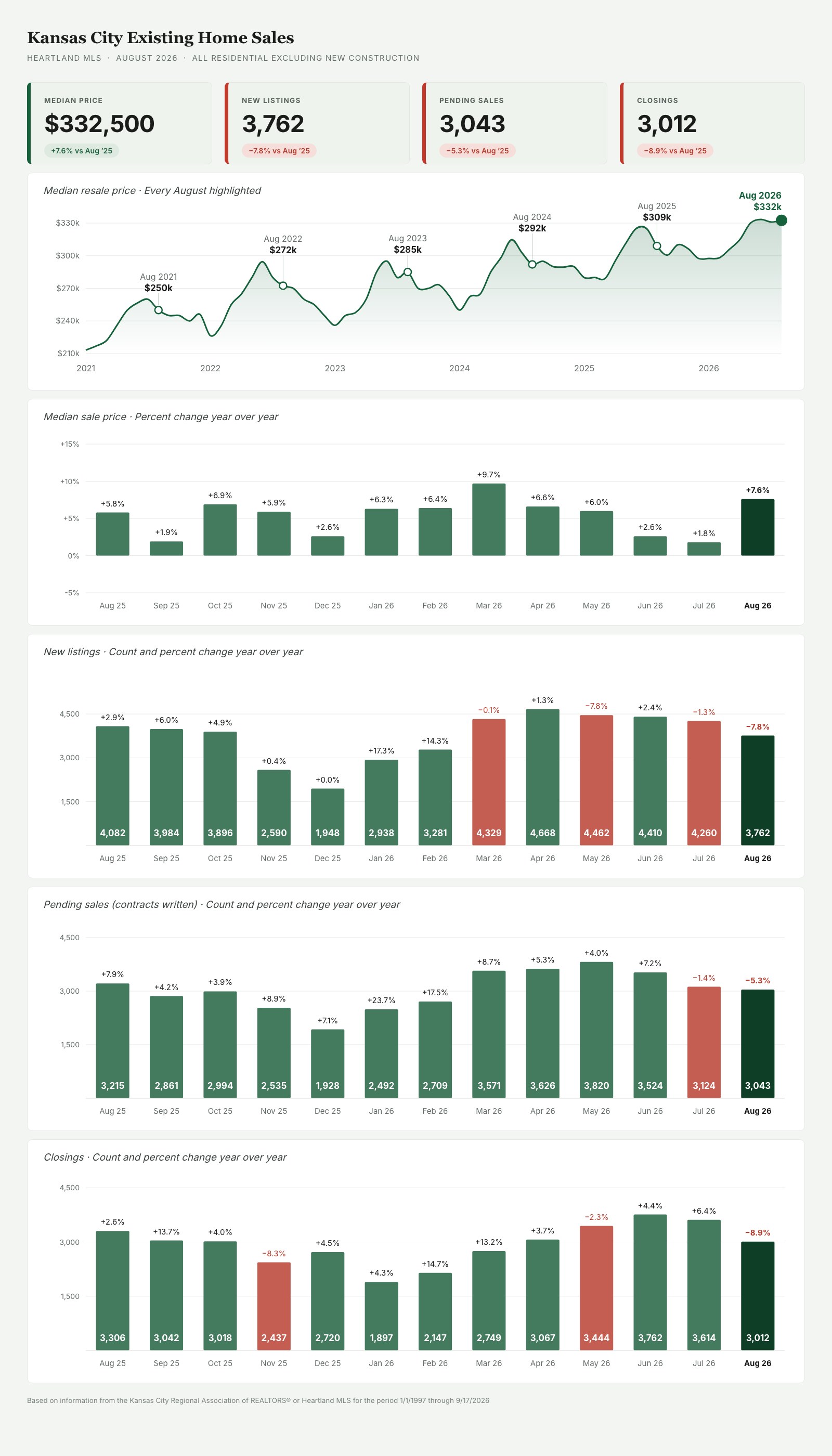
Kansas City's existing-home market slowed broadly in August. New listings, contracts written, and closings all finished below August 2025 — the first month this year that every volume measure moved lower. Prices did not follow: the median resale price reached $332,500, a new high and 7.6% above last August.
By Kyle Niemann
Market Pulse: August 2026
New Listings: Supply pulls back sharply
New listings: 3,762
Year over year: −7.8%
Fewer existing homes came to market than in August 2025, and the decline was much steeper than July's. This is the second consecutive month of year-over-year declines in new listings, and at −7.8% it is the largest drop we have recorded this year.
The pullback also broke a pattern. Through the spring, 2026 listing volume tracked within a few percent of 2025 month after month. August is the first clear separation from last year's pace, and it leaves buyers with less new inventory to choose from heading into fall.
Demand: Both closings and contracts turn lower
Closings: 3,012 (−8.9% YoY)
Pending sales: 3,043 (−5.3% YoY)
Completed sales fell 8.9% from August 2025. That is a significant reversal: closings had run ahead of last year every month from January through July, and August is the first month of 2026 to finish behind the prior year.
Contracts written also declined, down 5.3% year over year. July's post flagged the sharp deceleration in contract activity and asked whether it was a seasonal pause or something more sustained. August did not reverse it. Contract volume slipped further below last year, and the softer closing numbers are consistent with the weaker contract pace that began in July.
What this means for you
Sellers
Prices are holding, but the buyer pool is thinner than it was a year ago. With closings down nearly 9% and contracts down more than 5%, sellers are competing for a smaller pool of active buyers than last August. Preparation, condition, and realistic pricing carry more weight now than they did in the spring. Homes that need work or launch above the market are the ones most likely to sit.
Buyers
Fewer homes are coming to market, but fewer buyers are competing for them. New listings fell 7.8%, so selection is tighter — yet the decline in contract activity means less competition per home than earlier in the year. For a prepared buyer with financing in place, that combination can create more room to negotiate than the raw inventory numbers suggest.
Everyone
August was the softest month of 2026 on volume, with new listings, closings, and contracts all below last year. Prices have not followed. The median resale price reached $332,500, a new high for our series and 7.6% above August 2025. The market is transacting less, but it is not discounting.
Headwinds: Volume decline, affordability, and a thinner pipeline
The clearest headwind in August is that the slowdown broadened. In July the weakness was confined to contract activity while closings stayed strong. In August it reached all three volume measures at once — new listings, contracts, and closings each finished below August 2025. That is a more meaningful signal than any single month's move in one metric.
Affordability remains the persistent constraint. At a $332,500 median price, the market sits 33% above where it stood in August 2021, when the median was $250,000. Buyers need materially more income and down payment than they did five years ago, and elevated mortgage rates compound that gap.
Inventory is a more mixed picture than the listing decline alone implies. Metro-wide supply now stands at roughly 2.1 months. The tightest segment is the $300,000–$400,000 range at about 1.7 months, with $250,000–$300,000 close behind at 1.9 months. Both ends of the market are looser: homes under $150,000 sit at about 3.0 months and homes above $600,000 at 2.9 months. Supply has eased from the very tight readings earlier in the summer, but the core price bands remain firmly below the three-to-four months that would signal a balanced market.
The thinner contract pipeline also matters for what comes next. Closings follow contracts by roughly 30 to 60 days, so August's weaker contract volume points to continued softness in September and October closings. Two consecutive months of below-trend contract activity make the summer slowdown harder to read as a one-month seasonal pause.
Kansas City's market is not deteriorating — prices are at record levels and supply in the core price bands is still tight. But August marks the first month this year when volume moved against the market on every measure, and that is the trend worth watching into the fall.